
News & Reports
Over the last few years, wake-enhanced boating activity has been a hot topic for many landowners, lake groups, recreationists, and town boards. In the last year, it’s been an increasingly big concern for many Iron County residents. This is a complicated issue with lots of questions to be answered. In an effort to provide a time and space for folks to come get educated and allow for questions and answers, I have organized a wake-enhanced recreation forum. The forum will take place at the Mercer Community Center on Wednesday, November 12th , from 6:00-8:00 pm. There will be a diverse group of panelists from all sides of the issue to address questions from the audience. My hope is that this will be a time and place for town board members, landowners, lake groups, and recreationists to learn about this issue to help make informed decisions.
Turtle Flambeau Flowage & Trude Lake Property Owners’ Association, Inc.
Annual Membership meeting
Saturday June 21, 2025, at the Mercer Community Center, 2648 W. Margaret Street, Mercer, WI
10:00 am – 12:00 noon
- Call to Order:
- Attendance:
- Members and Board members introduced themselves.
- Minutes of June 22, 2024, meeting
- Treasurer’s Report
- Elections (vote on):
Secretary – Todd Jirous
Treasurer – Roger Nelson
Director – Jeff Wilson
Director – Troy Tipton
Director – Open
- Presentation
Mary Jung and John Richter – Wake boats and their impact on Northern Wisconsin lakes
BREAK
- Updates on Committees
- President’s Report- Randy Schubert.
- Water Level- Millard Johnson
- Fish Management- Jim Kohl.
- Water Quality- Todd Jirous.
- Invasive Species- Randy Payne
- Membership Committee- Roger Nelson
- Communication Committee- Troy Tipton/Terry Daulton
- Old Business
- Wake Boats – Millard Johnson
- Aquatic Invasive Species grant applications/opportunities for partnering with Burke Center – Randy Payne/Valerie Damstra
- New Business
- Future committee chairs/volunteers
- 100 Anniversary of the Turtle Flambeau Flowage
- Discuss dates for 2026 Annual Meeting
Any other business for the Association
Adjourn
ACTION ALERT: DNR to Hold Aquatic Plant Management Rules Revision Roadshows
Agency provides four opportunities for public comment on changes to NR 107 and NR 109, the administrative rules covering aquatic plant management.
The Wisconsin Dept. of Natural Resources is pursuing revisions and changes to the administrative rules governing aquatic plant management in the state. This is similar to an effort to update the rules a few years ago. That effort ended when, in the midst of attempts to address concerns on the part of various stakeholders, the deadline passed for the rule changes to be enacted.
The first draft of the rule has not been released, but the agency is spending the first part of 2025 collecting feedback from stakeholders, impacted businesses, and the general public. Having already presented on the rules to industry groups and to attendees of the 2025 Wisconsin Lakes & Rivers Convention, the APM rulemaking staff is going on the road, with an APM Rulemaking Roadshow, starting today In Oshkosh.
Public input will follow a brief presentation on the rules changes by DNR staff. These events are in person and no virtual option will be available.
For more information, check out the Aquatic Plant Management Rules page from WDNR and scroll down to find info on the public meetings and other ways to comment.
Roadshow dates and times:
June 4, 4 p.m. – UW Extension – Oshkosh, 625 E. County Rd Y, Ste 600, Oshkosh
June 5, 4 p.m. – Oconomowoc Public Library – Lyke Meeting Room, 200 W. South St., Oconomowoc
June 10, 4 p.m. – Hayward High School Auditorium, 10320 N. Greenwood Ln, Hayward
June 11, 4 p.m. – Nicolet College – Northwoods Center Conference Space, 5350 College Dr., Rhinelander
How to participate:
- Public input will follow a brief presentation on the rules changes by DNR staff.
- These events are in person and no virtual option will be available.
- For more information, check out the Aquatic Plant Management Rules page from WDNR and scroll down to find info on the public meetings and other ways to comment.
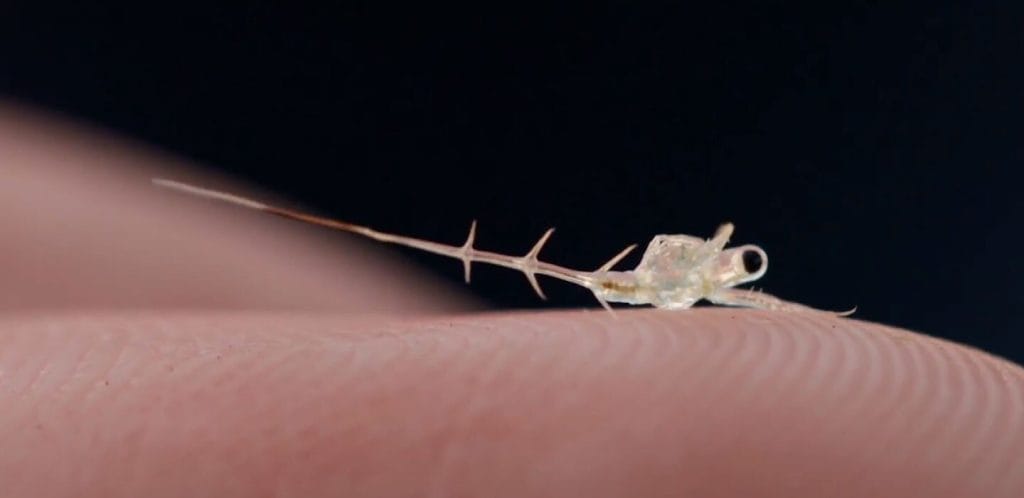
Iron County, WI – June 2, 2025 – The presence of the spiny waterflea (Bythotrephes longimanus), a regulated NR40 species, has been verified in Sandy Beach Lake, located in the American Legion State Forest in Iron County, Wisconsin.
Initial evidence of the spiny waterflea was documented in the summer of 2023 by Zach Wilson, former Conservation Specialist with the Iron County Land & Water Conservation Department (LWCD). Wilson captured photographic evidence during routine lake monitoring efforts, which prompted further investigation.
In 2024, Wisconsin Department of Natural Resources (WI DNR) staff members Dara Filmore and Matt Boehlke were asked to conduct follow-up monitoring. Zooplankton tows were collected from the lake and sent to the Wisconsin State Lab of Hygiene. A quantitative analysis of the sample was performed by the lab. This allowed for confirmation of the presence of a single spiny waterflea, indicating that the current population density remains extremely low.
Spiny waterfleas are an aquatic invasive species known for their negative impacts on the aquatic food web. They reduce the abundance of native zooplankton available, which in turn reduces food availability for juvenile fish and other aquatic organisms. Zach Lawson, DNR Fisheries Biologist for Iron and Ashland counties, says that this is especially concerning for walleye and yellow perch in larval and juvenile stages, which are dependent on zooplankton for survival. Reduced food availability for these species can reduce growth rates and potentially impact overwinter survival rates.
At present, there is no effective strategy for controlling spiny waterflea; therefore, prevention and early detection remain the most critical approaches to prevent further spread. Here is what YOU can do to help stop the spread of spiny waterflea:
- Inspect and remove all aquatic plants and animals from boats, trailers, and gear. Never move live fish, plants, or water from one waterbody to another. Wipe all fishing lines clean.
- Drain water from live wells, bilges, and motors before leaving any waterbody.
- Rinse watercraft, trailers, and equipment with hot water when possible.
- Dry your boat, trailer, bait buckets, and other equipment thoroughly for at least 5 days or wipe down with a towel before moving to a new water body.
The Iron Co LWCD will continue to work with WI DNR to monitor throughout Iron County and evaluate strategies as necessary.
For more information about aquatic invasive species and what you can do to help, please visit https://dnr.wisconsin.gov/topic/Invasives/fact/SpinyWaterFlea.
Contact: Rayona Suelflow
Iron County Land & Water Conservation Department
Phone: 715-561-2234, ext. 1
Email: rsuelflow@ironcountywi.org
Website: ironcountylwcd.com